
Those aren’t typos. They’re the actual hydro bills of a Milton homeowner with a 10 kW solar system — and they tell a story worth understanding before you sign anything with a solar company.
Paul West, P.Eng., VP Sales at Solar Direct Canada, presented these numbers at the Milton Future House 2026 event hosted by Sustainable Milton on March 28th. If you attended and would like a copy of the slide deck, email Paul directly at paul@solardirectcanada.com. The room was full of homeowners asking the same questions we hear every week: Is solar really worth it? How does it actually work in winter? What’s the catch?
Here’s what Paul showed them.
The Grid Is Your Battery — and It’s a Good One
Most people picture solar as panels on the roof powering the house during the day, with nothing left over for evening. That’s not how net metering works.
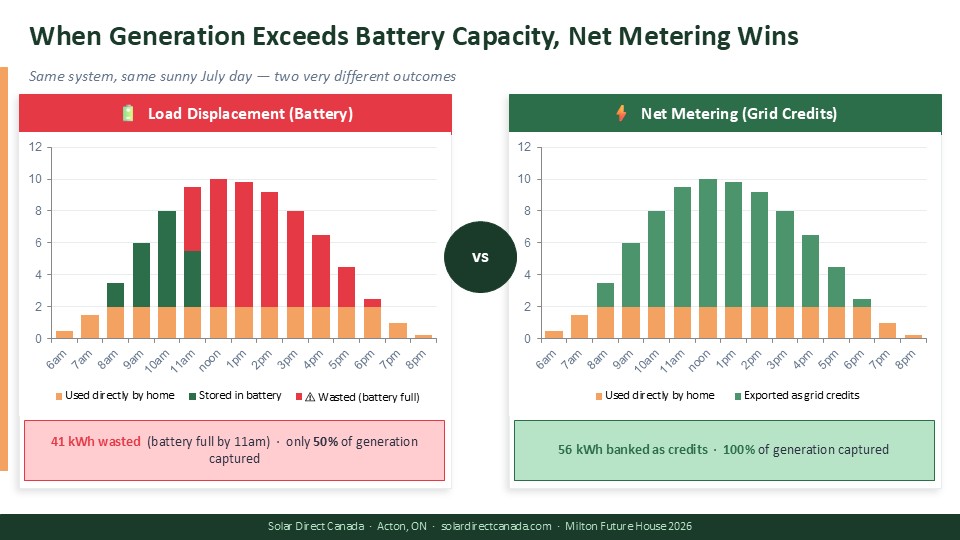
Under net metering, every kilowatt-hour your panels generate beyond what your home needs at that moment gets exported to the grid — and you receive a credit on your bill. Hydro rates in Ontario vary by time of day, and solar panels happen to peak during the higher-rate daytime hours. So when you export, you’re crediting yourself at a good rate. When you draw power back in the evening, you’re buying at a blended rate. The math works in your favour — by roughly 1.5 times.
Send 56 kWh to the grid on a summer day. Draw back the equivalent of 84 kWh in purchasing power. The grid doesn’t degrade, doesn’t need replacing, and has unlimited capacity. Under Ontario Regulation 541/05, you have a 12-month rolling window to use your credits — a well-sized system draws them down comfortably over winter.
What Real Bills Look Like
A peak summer billing period: The system generated far more than the household consumed. After all credits were applied, the total owing was $38.32.
A winter billing period: Short days, low sun angles, much less generation — but the credits accumulated during high-production months covered most of the shortfall. Net payment: $31.60 for 575 kWh of electricity consumed. That works out to roughly 5.5¢/kWh, compared to the 20¢+ the same household would have paid without solar.
Worth noting: utility billing periods don’t align neatly with calendar months. A bill issued in January might cover a metering period spanning mid-December to mid-January, depending on when the utility reads your meter. The credits and charges shown reflect actual metered periods — which is exactly how it should be read.
At the end of the winter billing period shown, this household still had $770 in banked credits — with several months remaining in their 12-month window.
Output Varies — That’s Normal, and It’s the Point
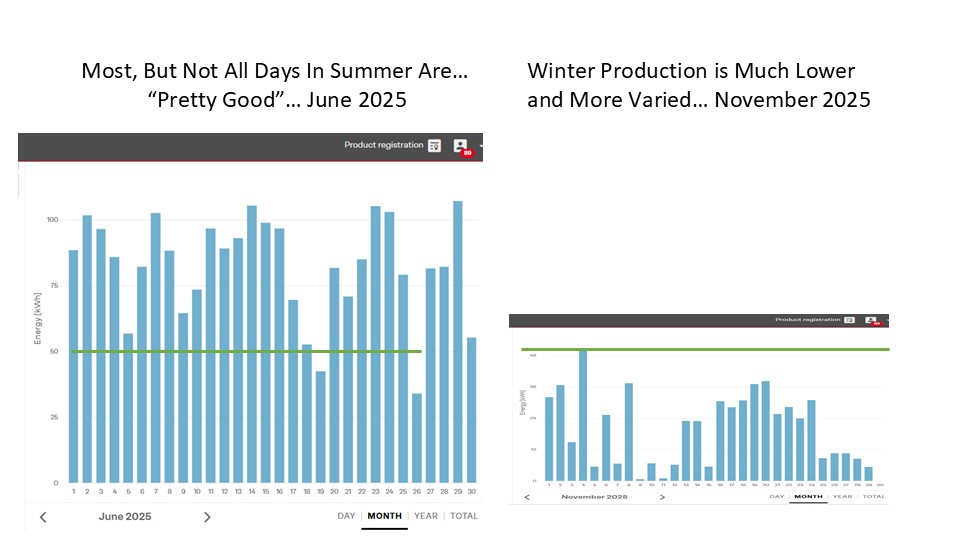
One thing Paul showed the audience that most solar companies don’t talk about openly: generation varies a lot from day to day, and dramatically from season to season.
A perfect sunny day in late June produced 107 kWh. A cloudy day four days earlier produced 34 kWh. Summer can generate ten times what winter does. This isn’t a flaw — it’s exactly why net metering exists. The grid absorbs the summer surplus and gives it back in winter. That’s precisely what happened for this Milton homeowner.
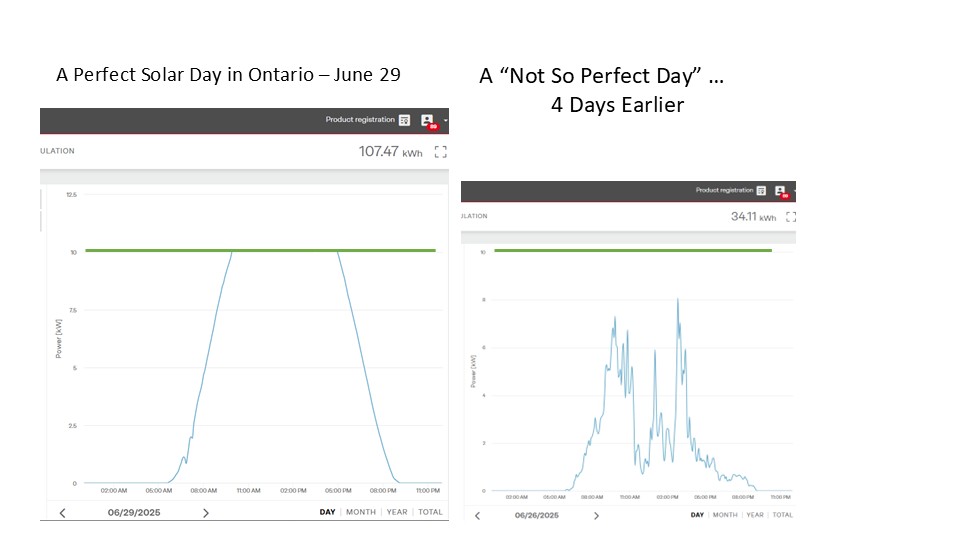
Two days in late June from the same 10 kW system: June 29 produced 107 kWh on a clear day; four days earlier, clouds cut output to 34 kWh. Net metering handles both equally well — every kWh generated is captured, whatever the weather.
The Bottom Line: Buying vs. Renting
Every month you pay a hydro bill, you’re renting your energy. The price goes up roughly 4–5% per year — it has for decades, and there’s no reason to expect that to change.
Financing solar with a home equity loan costs around $3,000 per year for 15 years (less for smaller system, more for larger systems). After that, your energy cost drops to near zero — while your neighbours’ bills keep climbing. By year 30, a typical Ontario household without solar could be paying close to $10,000 a year for electricity.
Solar doesn’t just reduce your bill. It lets you opt out of the rate-increase treadmill entirely.
GET A FREE SOLAR PANEL CONSULTATION
Contact us to learn how solar can tame your hydro bill.